
the wonder years
on repackaging nostalgia

I spent quite a bit of my childhood watching shows from another era that absolutely none of my peers knew. These were shows my mother grew up watching, shows that she knew and liked, and therefore I got to see them. Shows like Leave It To Beaver, The Monkees, The Mary Tyler Moore Show, The Bob Newhart Show, and The Wonder Years were staples in my house. The Wonder Years, especially, became a favourite.
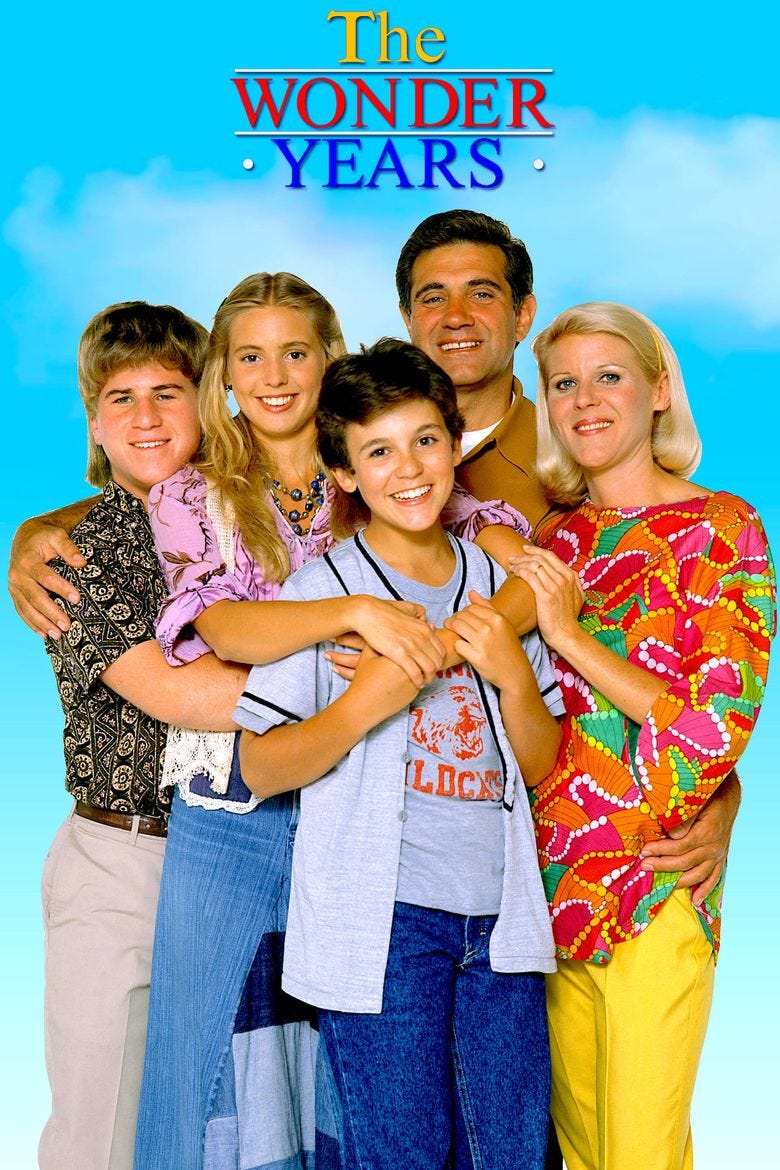
The Wonder Years is a show that follows 12-year-old Kevin Arnold, the youngest of the Arnold family, who are a white, middle-class American family living in American suburbia in the late 60s and early 70s. It chronicles Kevin’s growing pains, and is narrated not by child Kevin (played by Fred Savage) but by adult Kevin (voiced by Daniel Stern), who is reminiscing about his childhood while also telling all of the bumps along the way. As a sidenote: Daniel Stern isn’t credited, because despite being quite a prominent part of the show, he supposedly didn’t want his name attached to something he thought was quite silly.
I suppose The Wonder Years could have been silly and sentimental. It was, at times. But the fundamental part of the show is that kids were going through all the embarassments and joys of growing up while the world around them was changing at what seemed to be an alarming rate. We watch Kevin’s mom say loudly in a department store that his pants “don’t have enough room in the crotch,” to which adult Kevin narrates, “Gee, Mom, could you say that any louder? I don’t think the people in the back of the store heard you.” We watch Kevin be suitably flustered trying to call a girl he likes for the first time. We also see Kevin help organise a walkout at his school, in protest of the Vietnam War.
In the very first episode, we are introduced to Kevin, his best friend, and the girl he likes: Winnie. She is the quintessential girl next door. At first, the audience is lulled into thinking this is who she will be: she is his friend, a girl he has a crush on but can’t tell her how he feels because he’s twelve and everything feels life-changing at that age, and the girl next door who he gets to see around the neighbourhood. Her brother is in Vietnam, but Kevin has a good relationship with the brother, too; in other words, Winnie and her family are part of Kevin’s close circle.
Then, Winnie and her family get the news that her brother has been killed in Vietnam.
Kevin, at twelve, is suddenly forced to grapple with outside forces that have come crashing down in his quiet corner of suburbia. We don’t, to my memory, know if Winnie’s brother was drafted or whether he signed up, but the implication is that he was drafted. So he is dead, fighting a war that he possibly didn’t believe in, and in the second episode, Kevin attends a funeral for someone who defended him from his bully of an older brother.
While Kevin grows up, his sister goes to Vietnam War protests and joins the hippie movement. His brother seems incapable of growing up and bullies Kevin relentlessly, no matter how much Kevin’s parents chastise him. Kevin deals with growing pains as civil rights movement leaders are assassinated and US troops fire on Americans peacefully protesting.
Yes, the show is filled with nostalgia for a time gone by, but it doesn’t flinch away from the hardships of that time, too. Kevin lives in relative security but this is constatly punctured by the world outside. He is growing up in a world that is changing and evolving, and in a world that his parents sometimes don’t know how to navigate, either.
Perhaps one of the reasons this show has remained beloved is because every generation seems to go through a version of this. As a kid, I didn’t recognise everything in Kevin’s life. Still, his triumphs and tragedies felt familiar, even though I was growing up without the spectre of the Vietnam War and the hope of the civil rights movement. Instead, I was dealing with new spectres and hopes: the shock of 9/11, the fury at eroding of American democracy, the hope of a new dawn with the election of the first Black president. But the social situations Kevin faced remained the same.
A few years ago, with Fred Savage at the helm as executive producer, The Wonder Years got a reboot. This time, it was a Black middle-class family in the starring roles, and our main character became a 12-year-old Black boy called Dean Williams (played by Elisha Williams). Both of his parents work, his sister goes to protests and speaks on the Black Power movement, and his brother is in Vietnam. Dean has a crush on a girl he’s been friends with for years. He attends an integrated school, and one of his best friends is Jewish.
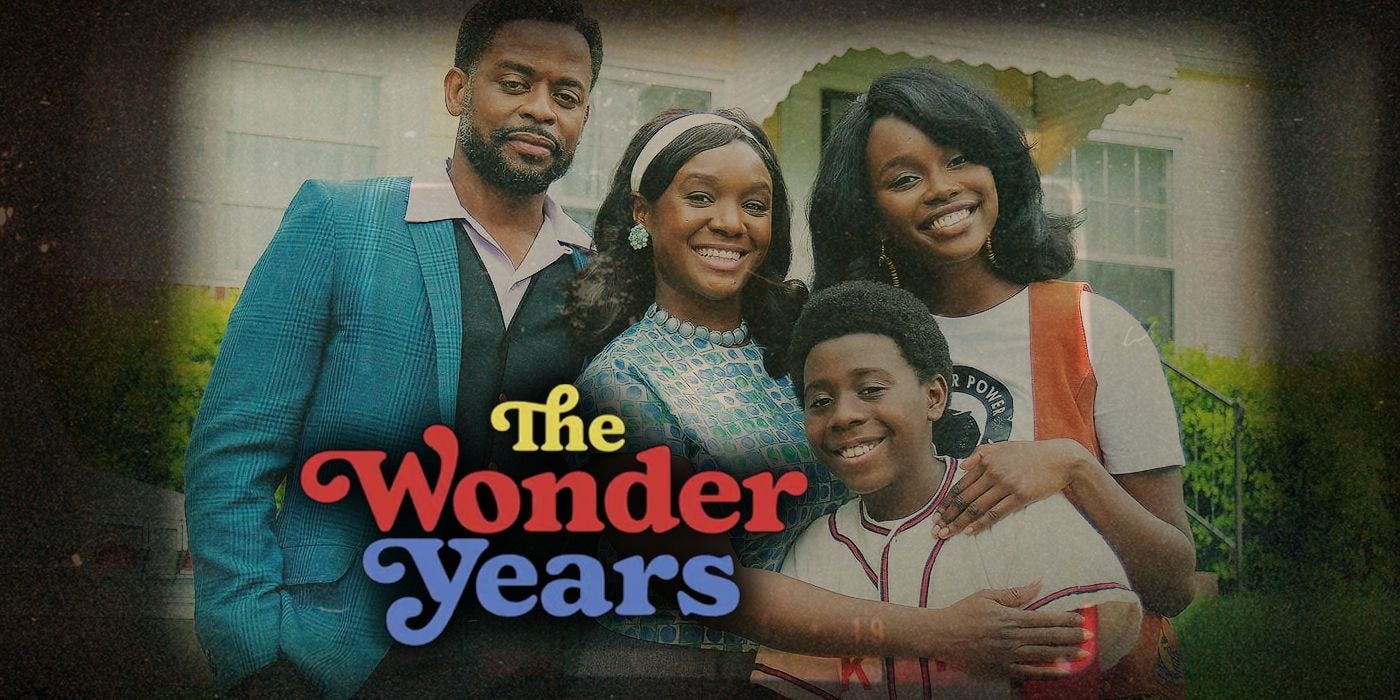
Dean, too, goes through trials and triumphs. He gets his first kiss. He complains about going to church. He gets excited to watch cartoons on TV, only to be told that he has to go to his grandparents’ farm in the country where there is - gasp - no TV. He attends his friend’s bar mitzvah, feeling out of place and resented by others as one of the only Black people there. He and his sister, unsure of what to do, are helped by a relative of his friend’s. As she reaches towards them, her sleeve slips, and Dean and his sister both see the number tattooed onto her arm. Suddenly, the moment becomes much more.
When Dean’s brother comes back from Vietnam, he finds that as a Black veteran, the opportunities afforded to his white counterparts are not presented to him, and so he enlists again. Dean’s parents talk to Dean about race. And through it all, Dean concentrates on what to him are much bigger problems. In the same episode where Dean and his sister are helped by his friend’s Holocaust survivor relative, Dean is dealing with a very adolescent problem: his girlfriend is upset that he’s friends with Keisa (the Winnie equivalent in this reboot), and wants him to cut her off. Dean does so reluctantly, only to make both girls angry with him, which in turn makes them friends. “At that moment, I really related to one part of Jewish culture: suffering,” adult Dean (voiced by Don Cheadle) quips as Keisa and his girlfriend walk away from him, arm in arm.
The Wonder Years and its reboot ultimately both capture nostalgia for the normal, everyday growing pains of childhood, but they do not romanticise it. The shows are not about wanting to relive times that were simpler; in fact, the shows very clearly show that times were not simpler. They only seemed simpler because the people living in them were younger, and the whole world didn’t seem complicated then. As an adult rewatching these shows, I’ve seen that message clearly, in the shot of the tattooed number on the woman’s arm, in the shot of Kevin walking into the empty hallway of his school just before the rest of the kids join him in walking out in protest, in the shot of Winnie crying at her brother’s funeral, in the shot of Dean’s parents sharing a glance with each other while Dean tells them about his best friend’s dad sneaking out of the house in the middle of the night.
To me, these shows are nostalgia done right. They capture the reality of growing up, from the perspective of a child who’s slowly learning that the world isn’t as easy as it once seemed to be. It’s reminiscing on a time when that innocence still lingered, but does so in a world where that innocence is so quickly shattered. Dean knows about the Holocaust. Kevin attends the funeral of a boy who wasn’t even twenty. Both Kevin and Dean watch their parents react to news on TV, not feeling connected to what has happened, but knowing that whatever has happened was important because it upset their parents.
These are not shows that make me sad for a time gone by, but they are shows that remind me what it was like to be a child. Hopefully, they remind all who watch to never let go of that child’s voice, and that no matter how big something feels, there’s always a way out of the other side.
(Sometimes with a lot of embarassing incidents along the way, which everyone will forget in a few days, so don’t even worry about it.)